What makes a shower smart? Not another screen.
Aquro: Smart Shower · PRODUCT DESIGN · 2025
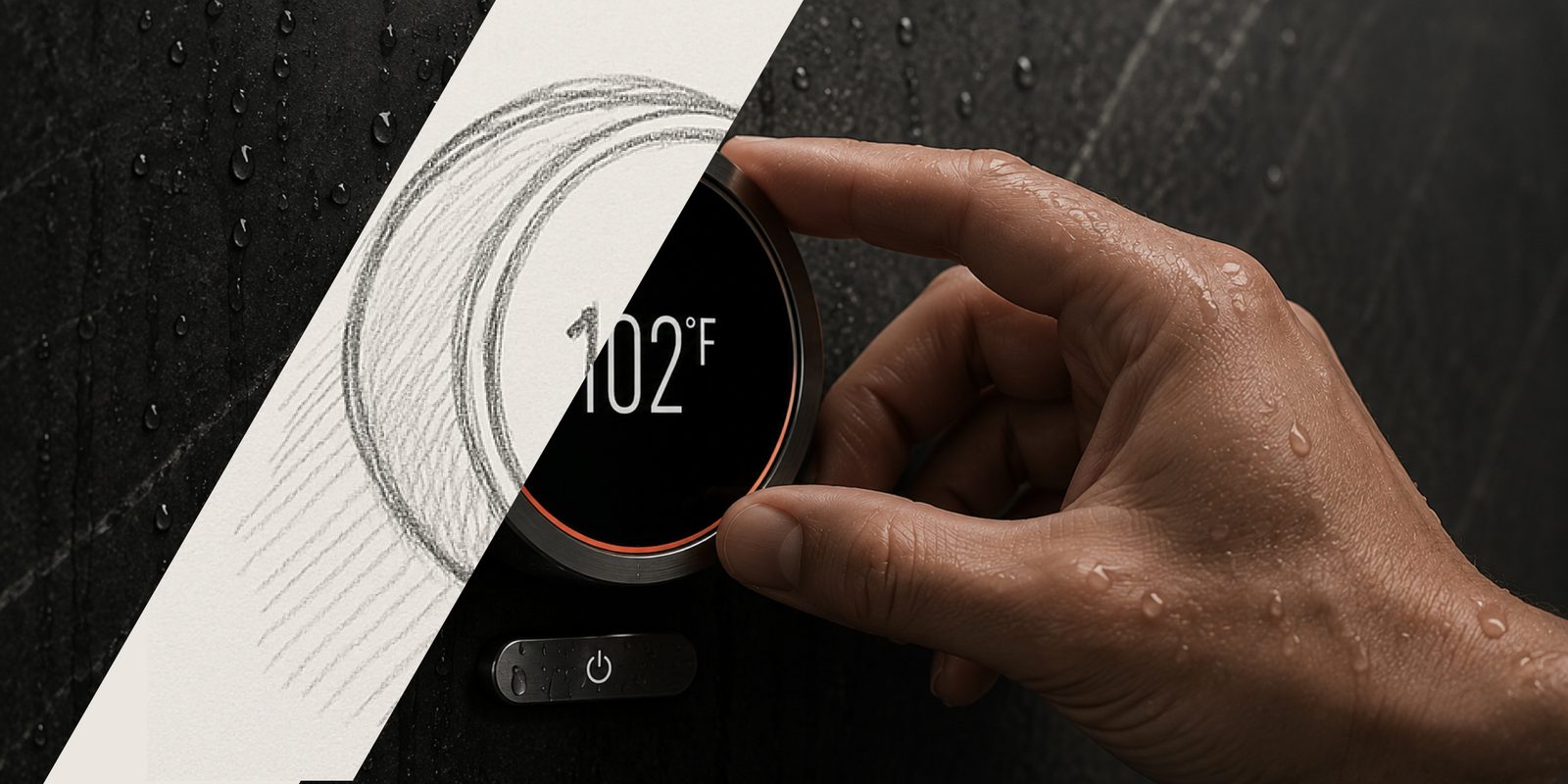
A smart shower built around one physical dial, personalization and automation without giving up a control you can feel.
Aquro explores a more dependable model for the smart shower: one that can prepare, remember and adapt without making a basic household task dependent on a touchscreen, phone or internet connection.
Properties
- role
- Product Designer
- type
- Product Design
- research
- 6 interviews · 95 reviews
- year
- 2025
- imagery
- AI-generated concept renders
- scope
- Research, competitive analysis, product strategy, feature prioritization, interaction design, connected-product definition
- product direction
- Professionally installed smart-shower system for premium residential renovations and new builds
If you read nothing else
- The problem: Smart showers fail exactly where a shower is used: wet hands and steam make screens unusable, and when the app or connection dies, the shower dies with it.
- What I did: Built a concept from 6 interviews and 95 clustered reviews: one physical dial on the outside, automation underneath.
- What changed: A complete product definition, argued from research and cut down to one physical dial: the core shower works with wet hands, offline, and without an account.
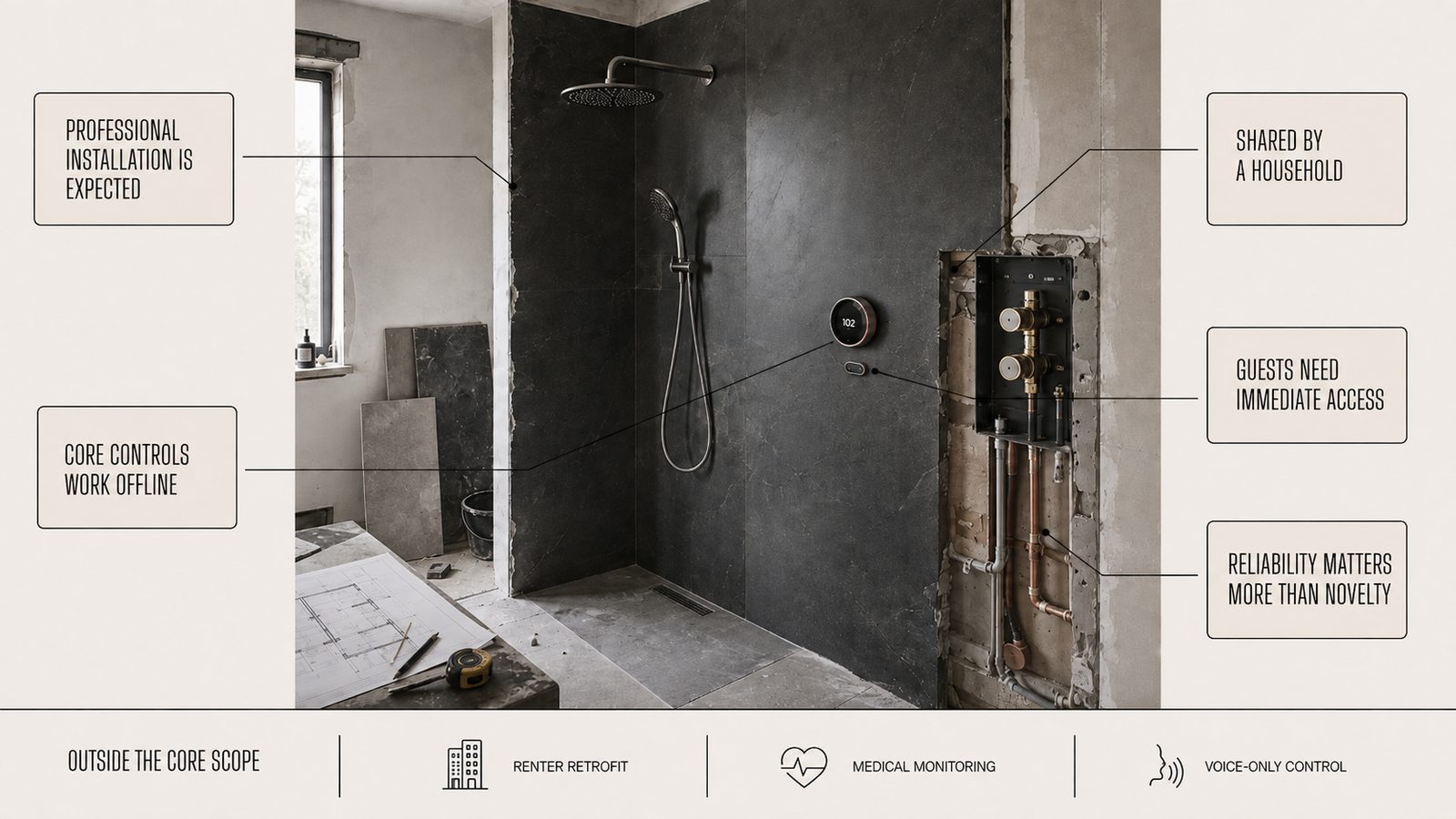
Existing products offered precise temperatures, presets and connected features, but users also described difficult installation, limited flow control, unreliable components and interfaces that became harder to operate with wet or soapy hands.
01, The contradiction
Smart showers are sold as a more convenient way to control water. In practice, several systems introduced friction into the most basic moments of the experience:
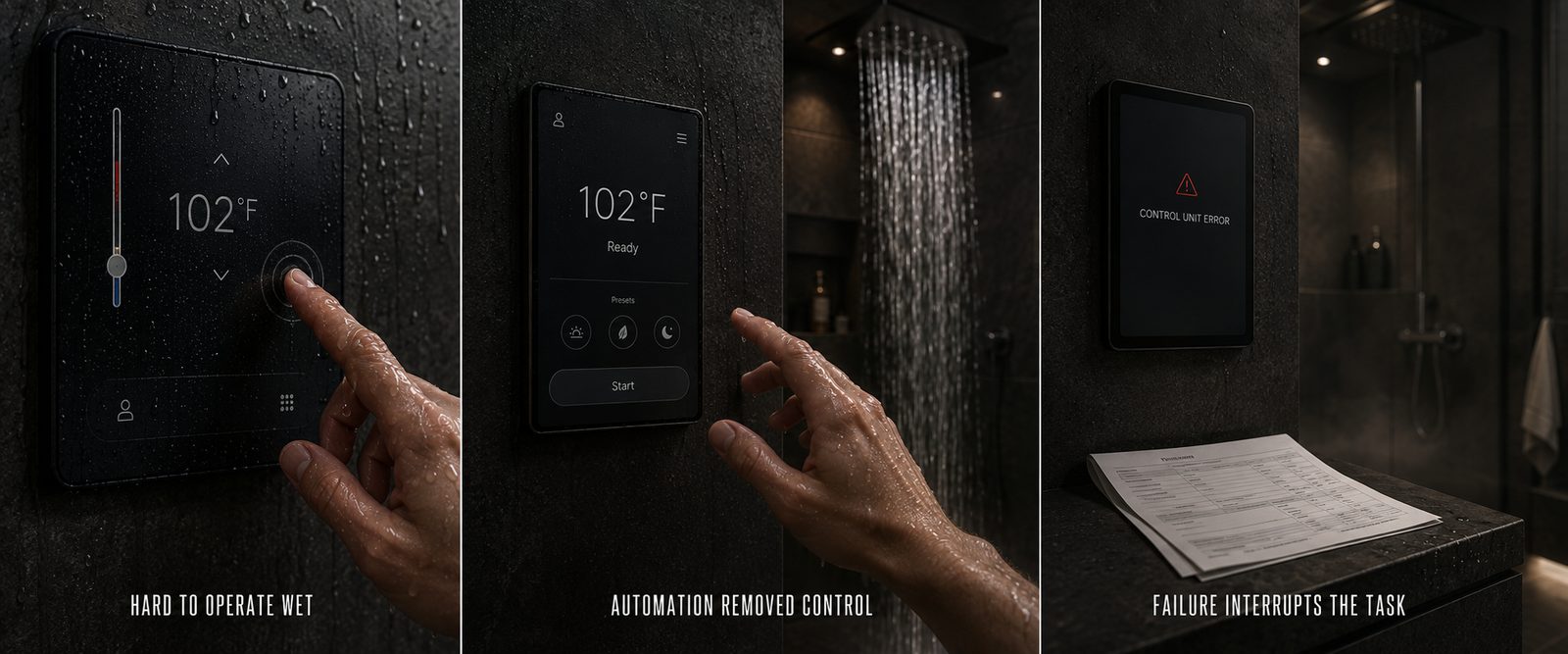
- Wet hands, visual controls, A shower is one of the least suitable environments for precise touchscreen input: wet hands, glasses off, steam everywhere, eyes not on the screen.
- More automation, less control, Some products made it easy to reach a target temperature but removed direct control over water flow, more technology, less influence over the shower itself.
- One failure stops the task, Reviews described systems going cold, shutting off unexpectedly, and costly controller replacements. Here a digital failure doesn’t disable a feature, it interrupts the shower.
Across reviews and interviews, people wanted something they could feel, not another screen.
02, The product problem
Current smart showers provide useful automation, but their screen-based controls, limited manual overrides and dependence on connected components can make an essential household product less usable and less dependable.
I narrowed it to one question and threw out anything that didn’t answer it:
How might a smart shower provide personalization and automation while preserving the immediacy, safety and reliability of physical control?
03, Who Aquro is for
The initial research touched families, luxury buyers, older adults, athletes and smart-home enthusiasts. Designing for all of them at once would have produced an unfocused product.
Aquro is positioned for owner-occupied homes undergoing a premium bathroom renovation or new build, professional installation is already expected, multiple people share the system, and buyers are judging the long-term reliability of a fixture, not a gadget. (A positioning decision from the competitive review, not a claim about market size.)
Primary user
Aquro is designed for a homeowner who wants connected-home convenience but expects the shower to remain straightforward.
Aquro is not positioned as a renter retrofit, medical device, voice-only product or universal replacement for every shower configuration.
04, Research
I structured the investigation around three questions:
- What do people value in smart showers?
- What causes frustration or distrust?
- Why would someone choose one over a conventional shower?
- 6, interviews, qualitative, treated as directional evidence rather than statistics
- 95, Amazon and Reddit reviews, AI-clustered into recurring pros, cons and discussion themes
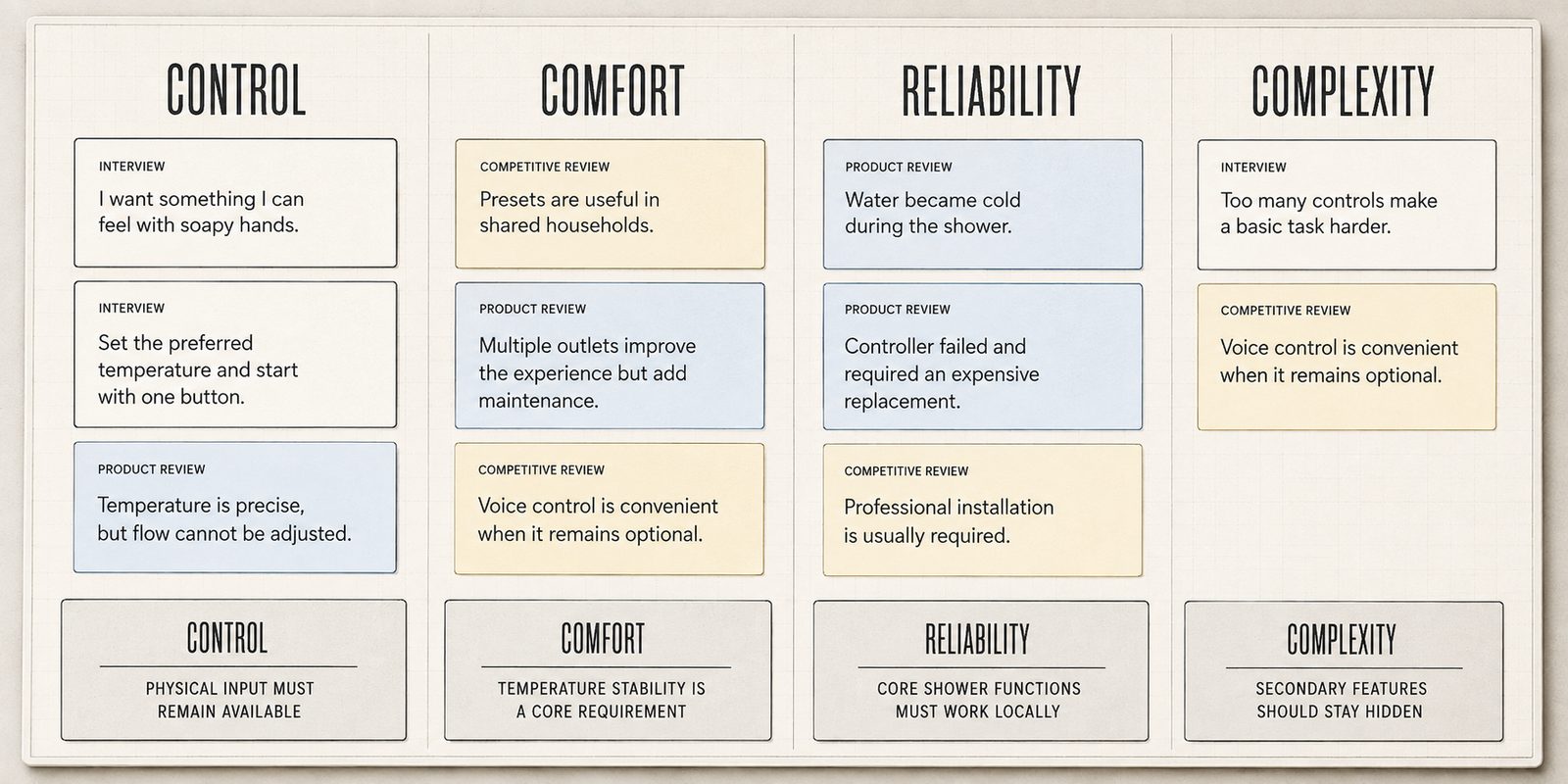
Because the sample was qualitative, I cut the unsupported satisfaction percentages from the original exploration rather than presenting them as measured results. And the original exploration’s long feature list wasn’t enough, for the revised definition, every core decision needed a visible connection to a user problem.
What the evidence changed
| Evidence | Product requirement | Design response |
|---|---|---|
| Touchscreens are difficult with wet or soapy hands | Frequent actions must work without precise tapping | Rotating physical ring and tactile feedback |
| Users value reaching and maintaining a preferred temperature | Temperature must remain the default control | Rotation adjusts temperature directly from the home state |
| Some systems remove direct flow adjustment | Automation must not replace manual flow control | Flow remains a first-level control during every shower |
| Presets are useful in shared households | Personalization must not lock users into a profile | Local profiles, guest mode and instant override |
| Digital failures can interrupt the entire shower | Core functions cannot depend on Wi-Fi or cloud services | Start, stop, temperature, flow and outlets operate locally |
| Repairs can be expensive and difficult to understand | Failures must be explained before service escalation | Plain-language diagnostics and professional service codes |
| Feature-heavy interfaces can overwhelm users | Complexity should appear only when requested | Progressive disclosure for secondary settings |
05, The product principles
I wrote five rules and held every decision after this point against them.
- Physical control comes first, Frequent actions cannot depend on precise taps, voice recognition or a phone.
- Smart behavior remains reversible, Aquro may prepare and remember, but the user can change the result immediately.
- The core shower works locally, Start, stop, temperature, flow and outlet selection remain available without an internet connection.
- Complexity appears only when requested, Temperature and water stay primary. Profiles, schedules and integrations sit behind them.
- Failure must be visible and recoverable, The interface explains what failed, what still works and what the user should do next.
06, Cutting the scope
The initial concept included voice assistants, a mobile application, aromatherapy, lighting, music, steam, wearables, health data, water monitoring, multiple outlets and predictive behavior. That feature set was too broad for one dependable product. The revised proposition separates the system into three layers, core, optional and removed.
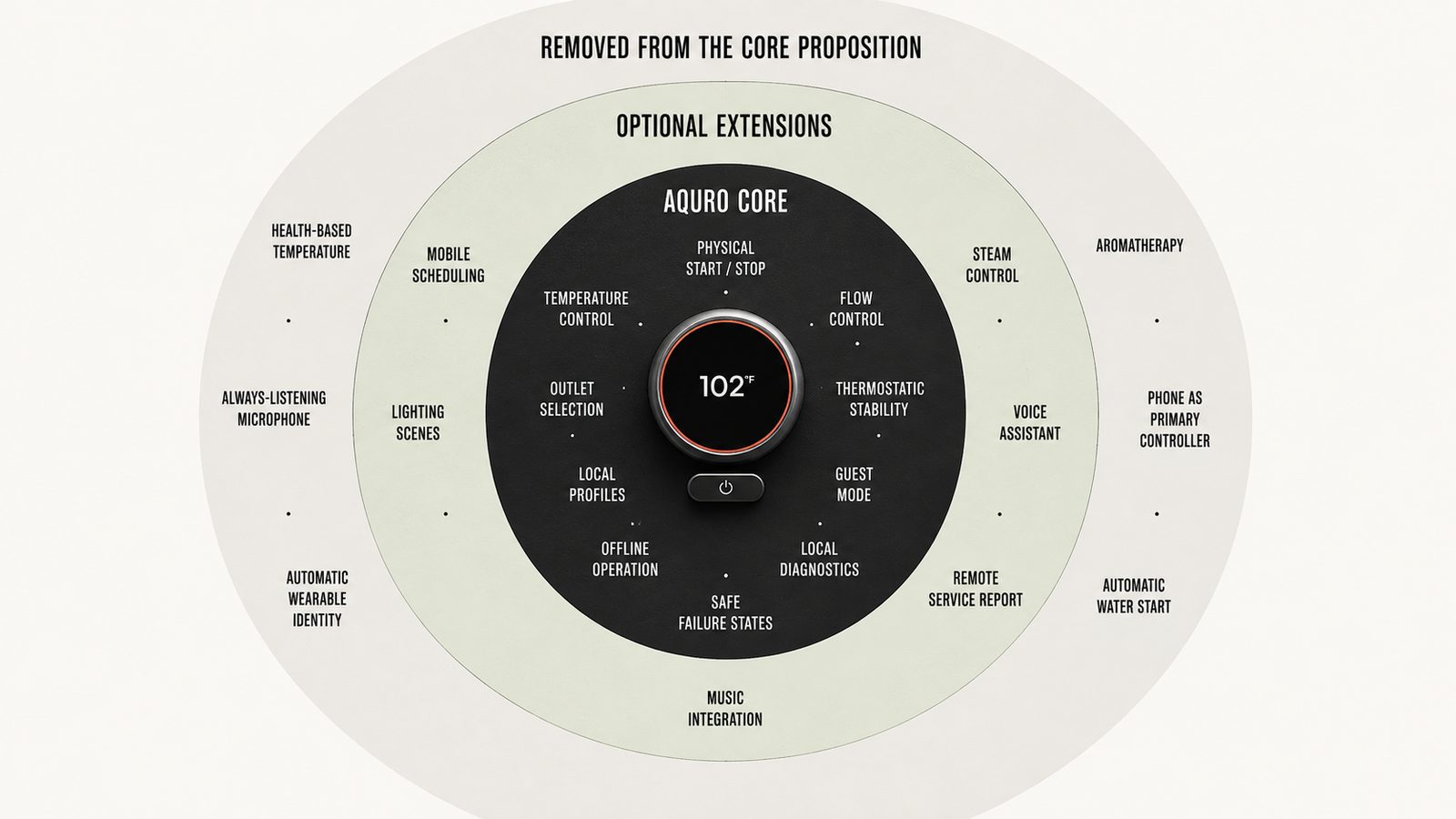
Aquro Core, essential control
- Dedicated physical start and stop
- Temperature adjustment
- Flow adjustment
- Outlet selection
- Thermostatic stability
- Visible system status
Personalization
- Local household profiles
- Guest mode
- Last-used setting recall
- Manual override at any time
Smart assistance
- Schedule-based preparation
- Basic water-use visibility
- Local diagnostics
- Pressure-aware outlet management
System requirements
- Offline core operation
- Safe temperature limits
- No account required
- Optional connectivity
- Clear recovery states
I cut wearable health data, aromatherapy, automatic identity and always-listening voice control. Each one added a privacy, safety or maintenance burden, and none of them answered the thing people actually complained about, that the shower stops being usable the moment the smart part misbehaves.
Cutting voice control has a real price. It was the one feature both the interviews and the reviews called genuinely convenient, as long as it stayed optional. Removing it from the core means there is no hands-free start, and someone with limited grip strength or reach loses an entry point. I kept it as an optional extension rather than a core promise, which is a compromise, not a solution.
07, Designing the controller
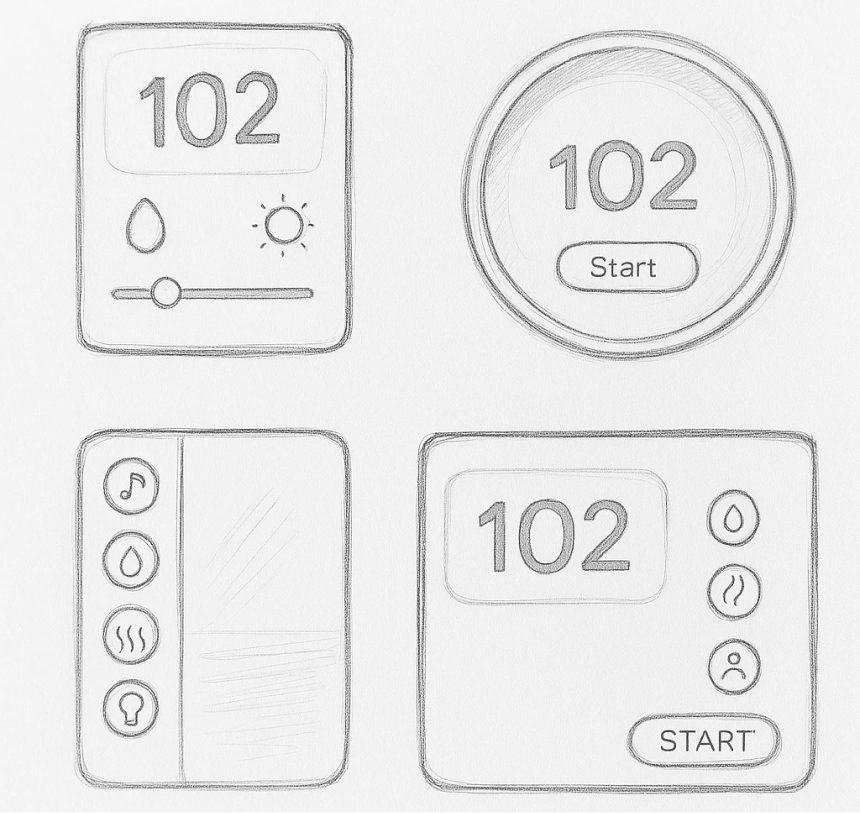
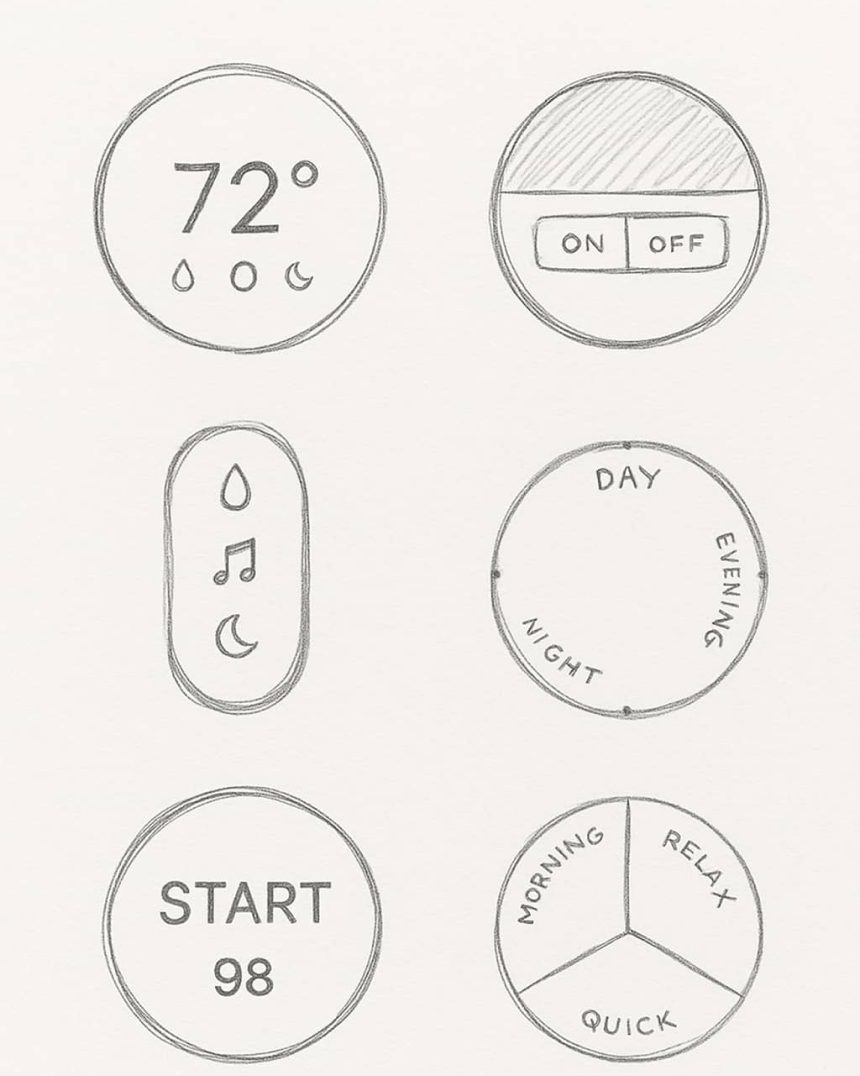
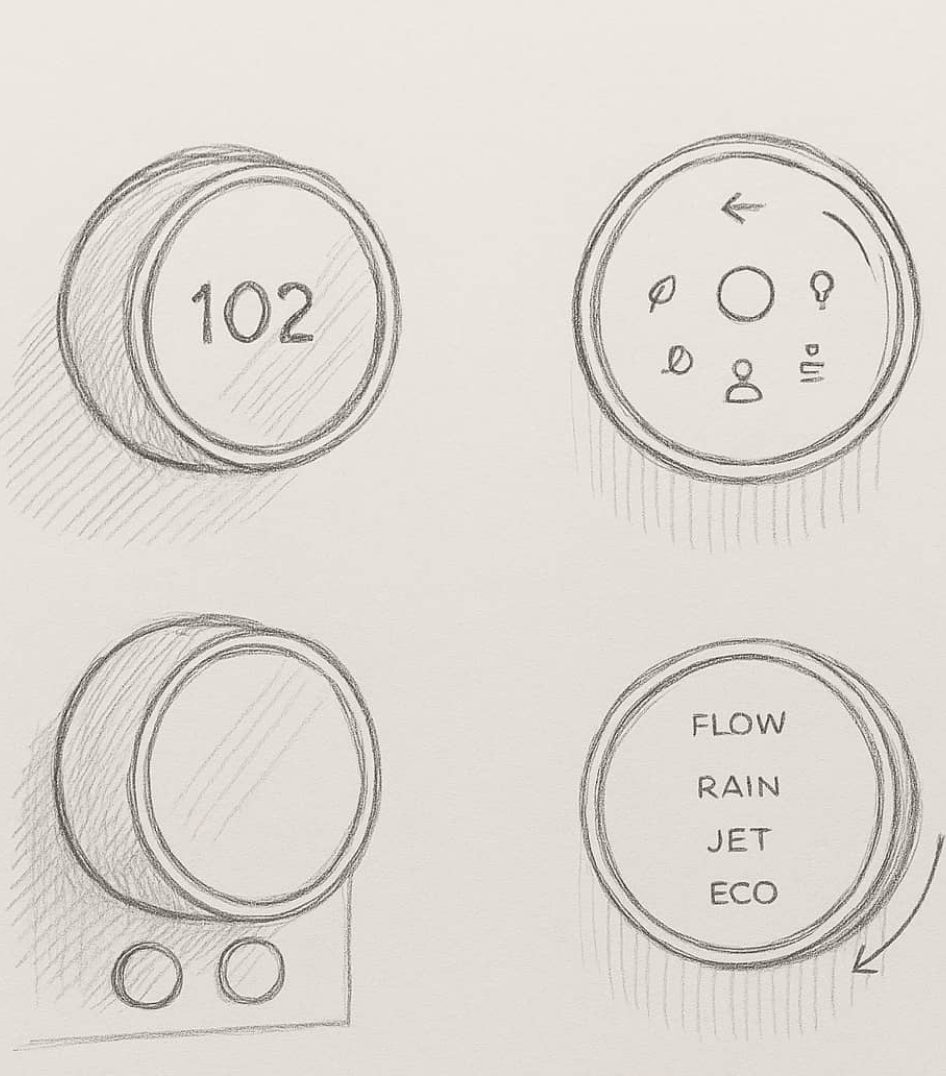
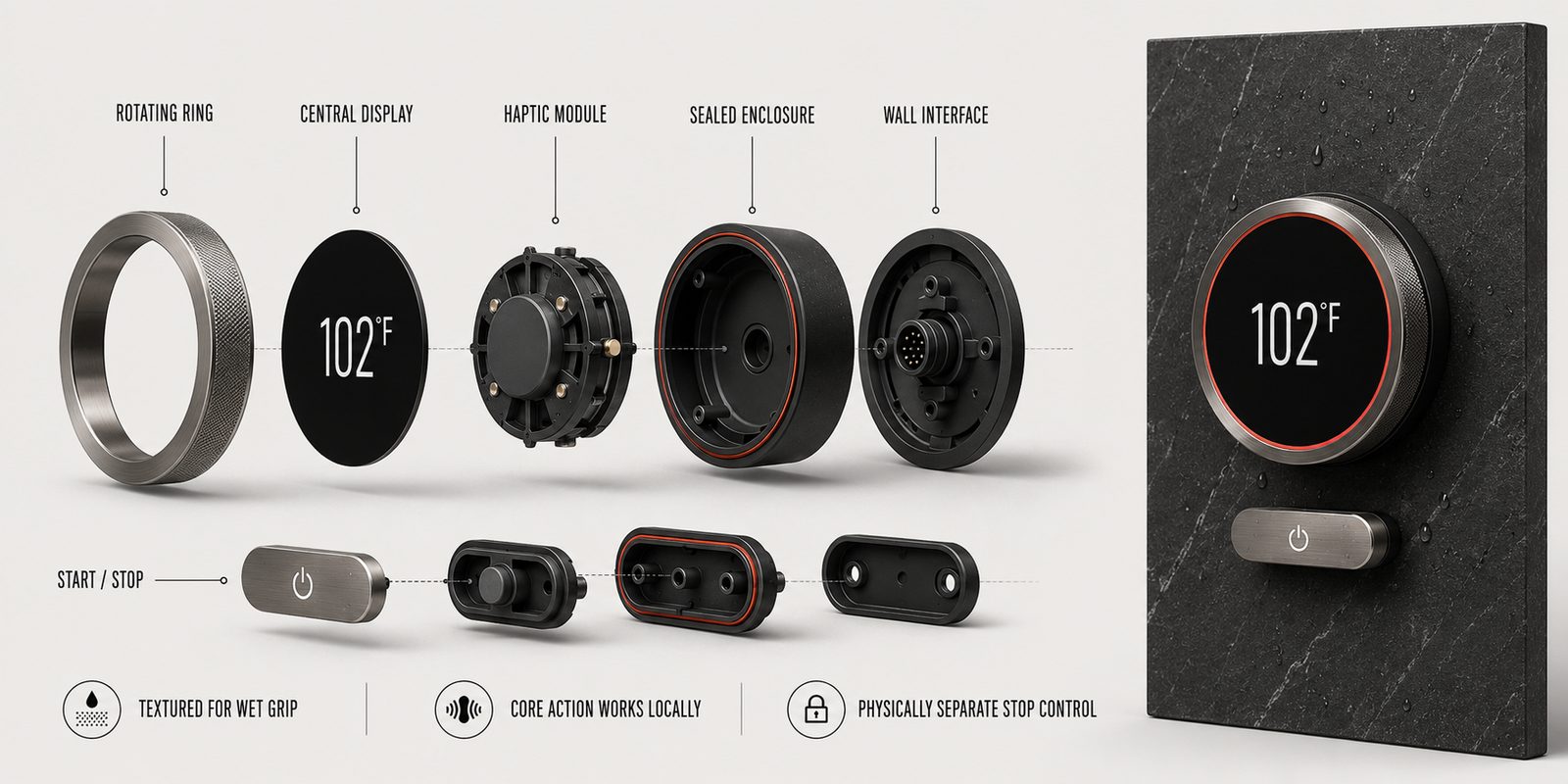
The early sketches explored three directions: a rectangular wall panel, touch-driven interfaces, and a continuous rotating ring. The panel lost because every adjustment on it is a targeted touch, the exact input wet hands are worst at. The ring won because rotation maps continuously onto a continuous value, and because it can be turned by someone who is not looking at it.
08, One physical language
Wet hands, steam, and glasses left on the counter make everyone a low-vision, low-dexterity user
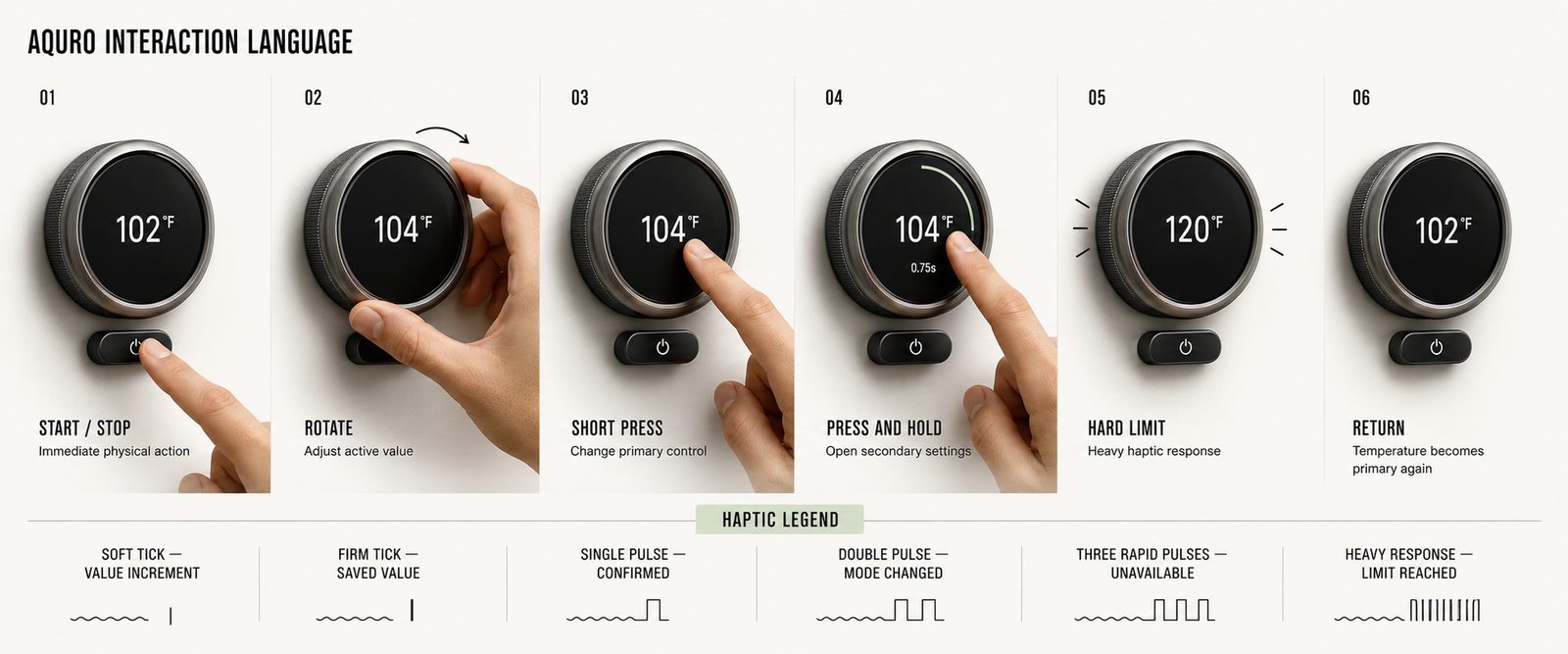
Aquro uses the same small set of actions throughout the system.
And to be precise about the screen: Aquro still has a display, because “no screens” would be a slogan rather than a position. The problem was never that information is shown, it is that input required looking. The ring is the input: it has detents, a wet-grip surface, and haptic feedback that marks each step and each mode change, so temperature can be adjusted by feel and count. The display exists to confirm, not to operate.
- Press start/stop, Starts or stops the water immediately.
- Rotate, Adjusts the currently active value.
- Short press, Moves between temperature, flow and outlet control.
- Press and hold, Opens secondary settings.
- Release and wait, Returns to temperature.
One dial with a modal short-press buys immediacy and costs discoverability: a first-time guest has no way to know that pressing moves between temperature, flow and outlet. I accepted that cost because guests overwhelmingly need one thing, water at a safe temperature, and that is the default state. It is also the first thing I would test.
09, The primary journey
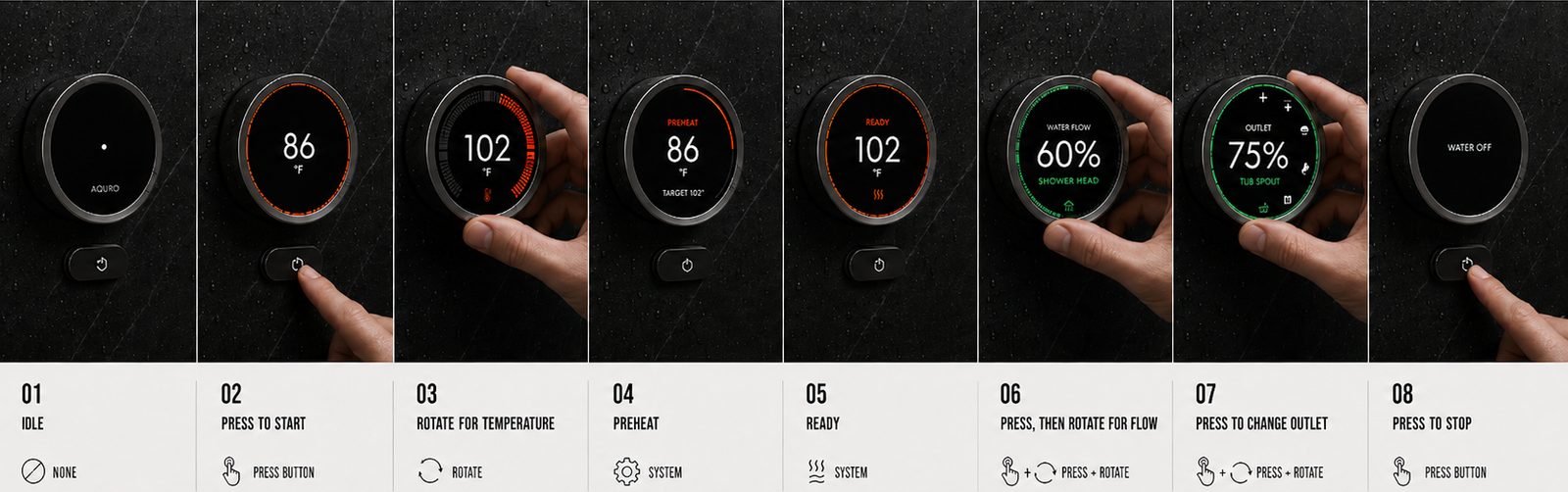
The core journey had to remain understandable without an app, account or instruction manual.
Profiles without lock-in
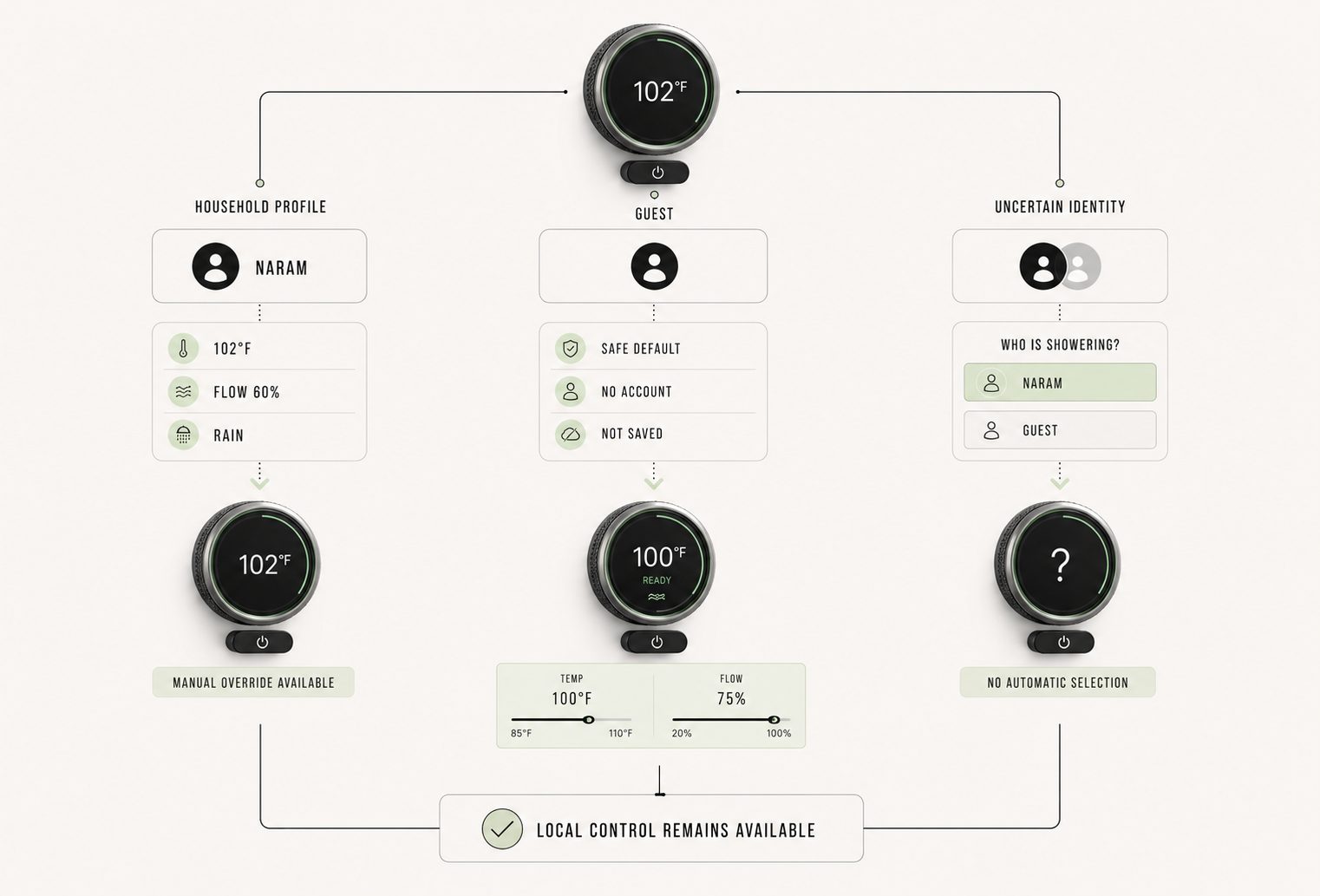
Profiles save repeated choices, but they never take control away from the person using the shower. A household profile can store temperature, flow, outlet and optional environmental settings, every value remains adjustable during the shower.
Aquro does not try to recognise anyone, automatic identity was one of the first things I cut. That makes profile selection a deliberate act: the last-used settings are what you get, switching profiles is a press-and-hold away, and guest mode is the default whenever no one has chosen otherwise. No account, a safe temperature, nothing saved.
Smart behavior with boundaries
The original proposal explored wearable recognition, predictive preheating, self-diagnosis and adaptive flow logic. The revised system keeps the useful behavior but gives each feature a clear boundary.
Aquro may prepare for a scheduled routine. It does not begin a normal shower without local confirmation. When a requested outlet combination cannot be supported, Aquro explains the limitation and offers an alternative. Aquro reports conditions it can directly observe. It does not claim to diagnose every problem in the household plumbing system.
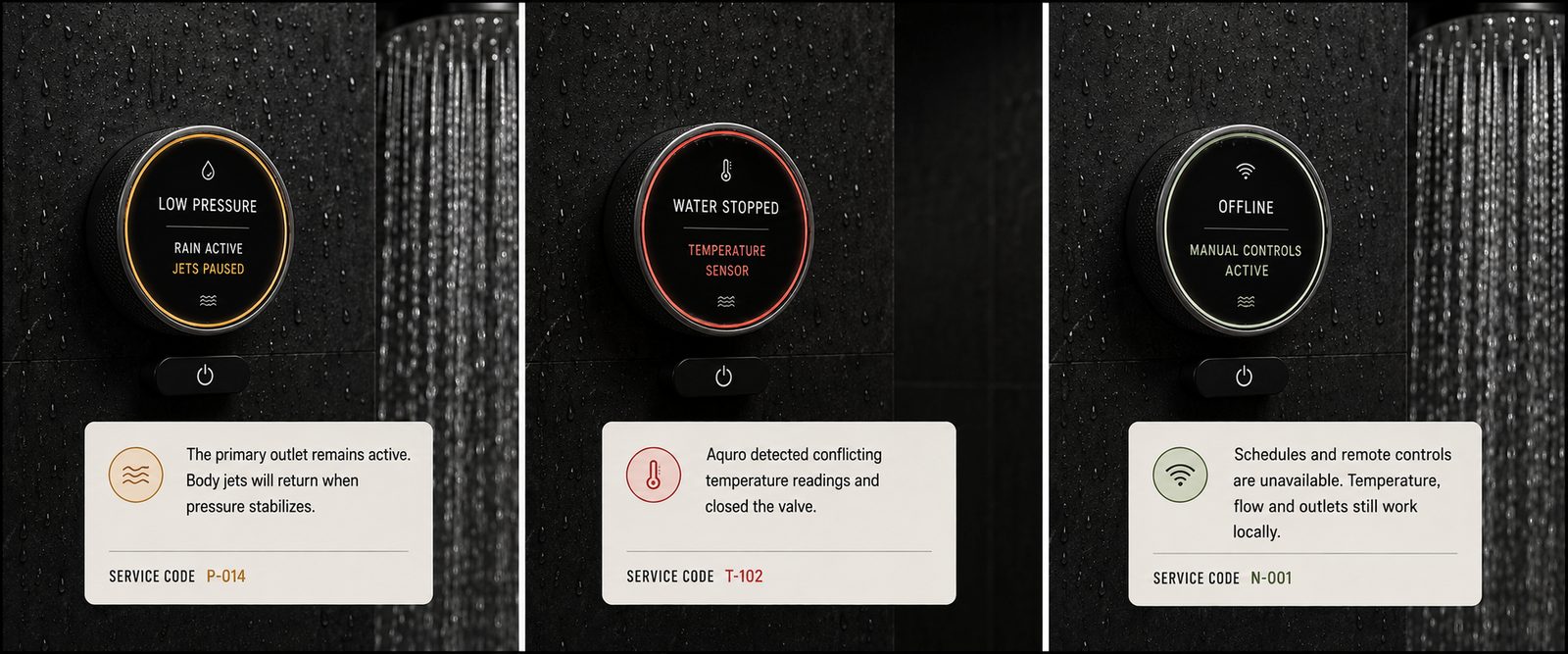
10, Safety shapes the interaction
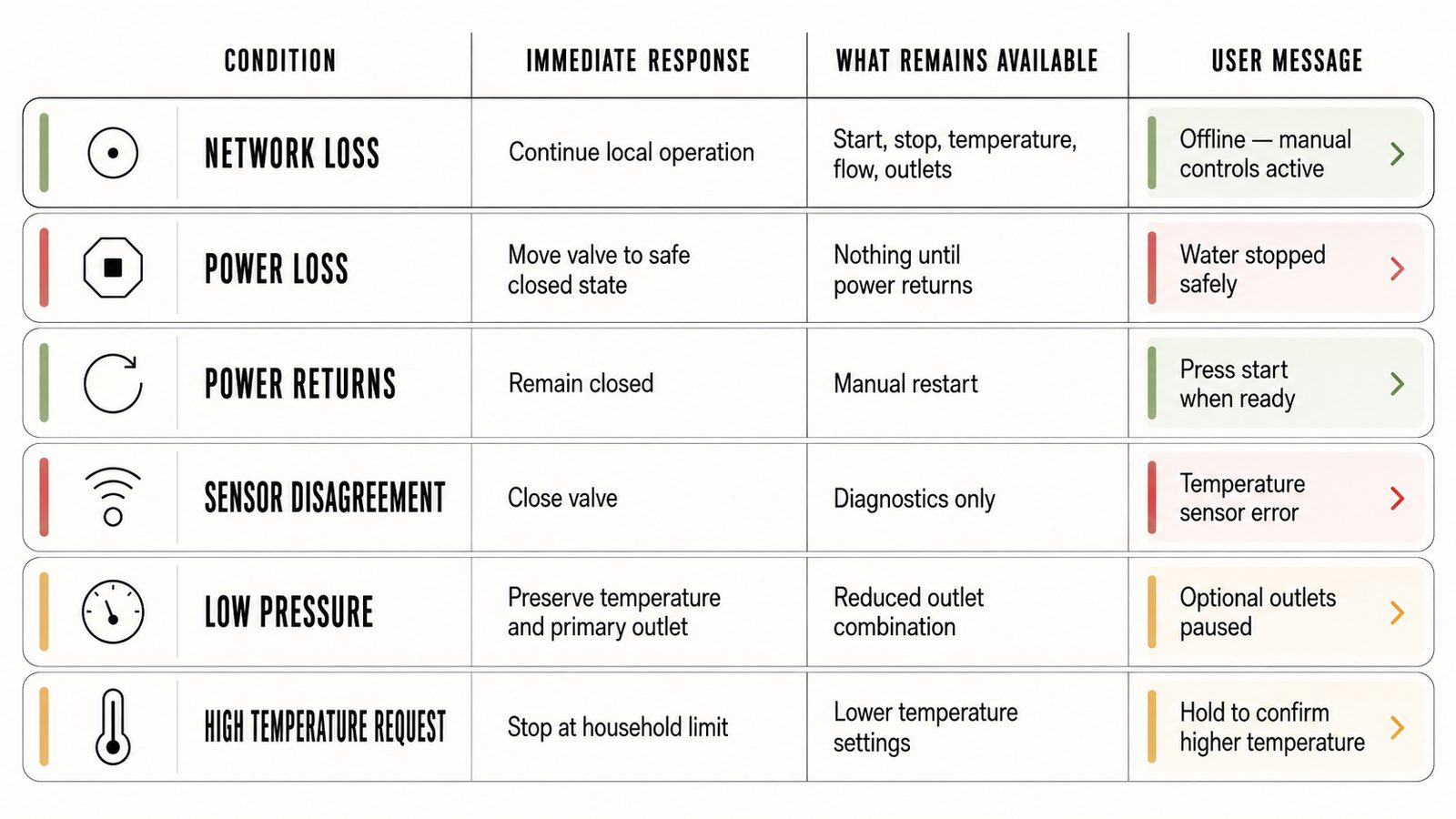
Aquro controls heat and water. Safety is part of the product behavior, not a later engineering annotation. The proposed system includes:
- A configurable household temperature ceiling
- Lower limits for child profiles
- Deliberate confirmation before crossing a high-temperature threshold
- A physical stop control that overrides every screen and mode
- No automatic restart after power returns
- Local operation during a network outage
- Valve closure when temperature sensors disagree
- Stable temperature prioritized over optional outlets during a pressure drop
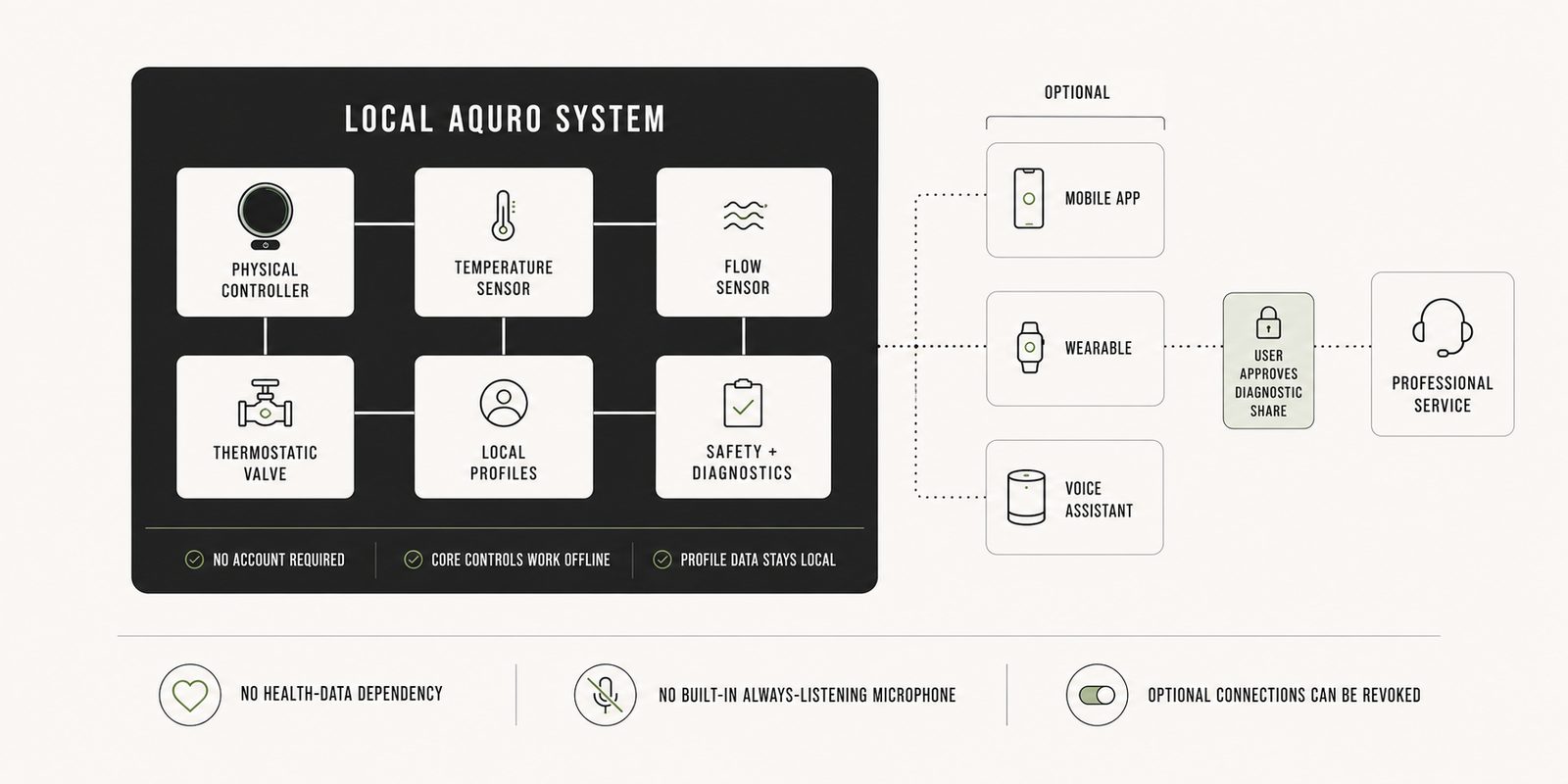
11, Privacy without dependency
Aquro does not need health data or continuous surveillance to provide personalization:
- Core profiles are stored locally, starting, stopping, temperature, flow, outlets and guest mode require no online account
- Wearables, mobile control and voice assistants stay optional; the core controller has no always-listening microphone
- Health-based temperature changes were cut, they raised sensitive-data and safety questions without being necessary to the core problem
12, The proposed product
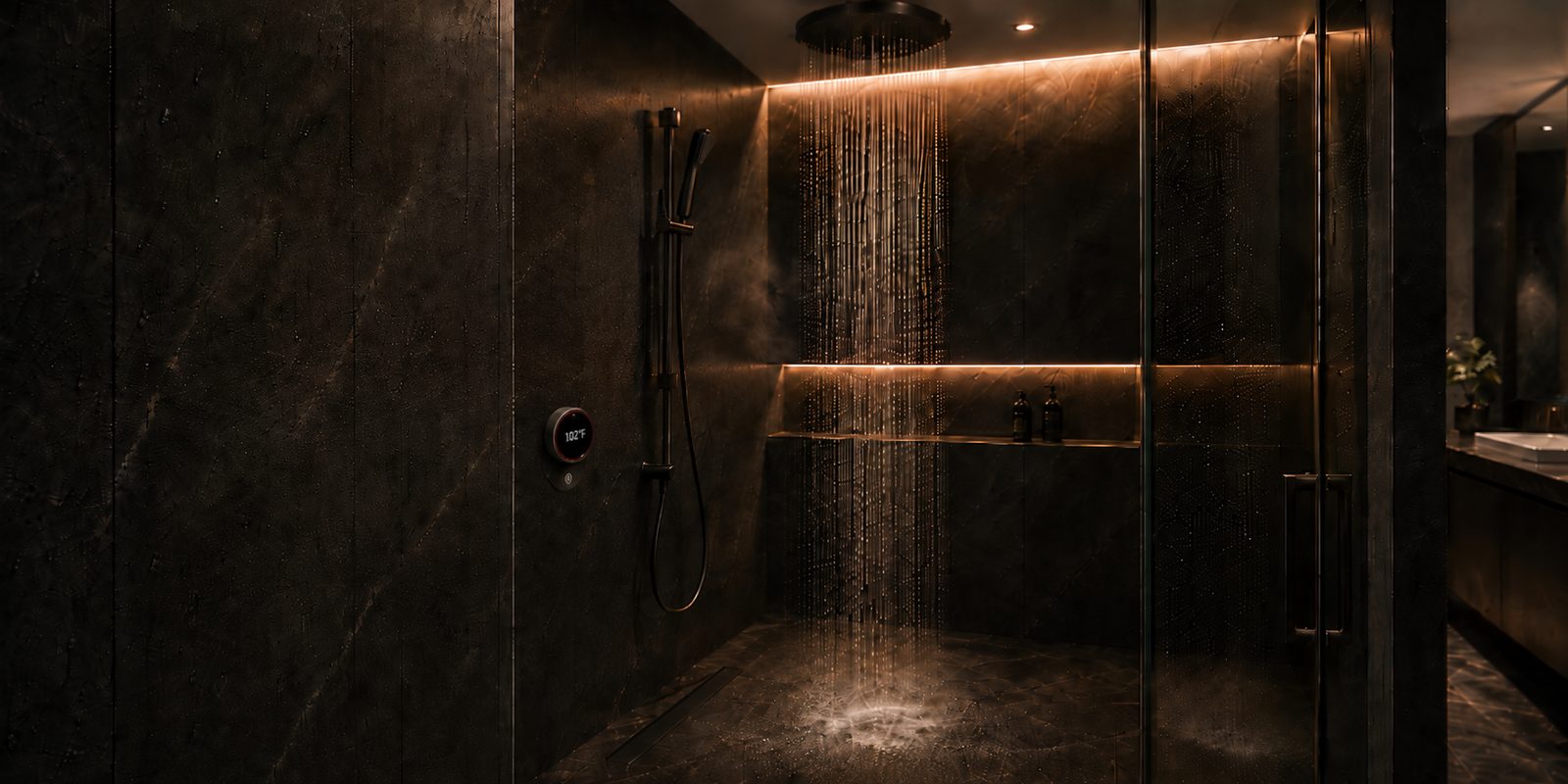
Aquro is not defined by the number of connected features it contains. Its value comes from the relationship between a dependable local core and a quieter smart layer:
It preps the shower without starting it, remembers people without locking anyone out, shows every change it makes, and still works when the connection dies.
13, What this concept still needs
Aquro is a product definition, not a validated design. Before anything else, I would 3D-print the ring and run a first-turn test with eight people, four who have never seen it, two over 65, two with reduced grip, with one instruction: “get the water to comfortable.” I’d measure time to a target temperature, whether they look at the display to do it, and whether they find outlet switching unprompted. The kill criterion is specific: if more than two of eight cannot change temperature without reading the display, the physical-first argument is wrong and the premise needs rebuilding, not the design.
14, What I learned
Aquro taught me more per week than any project before it, because almost none of it was screen design:
- Accessibility is situational, Wet hands, steam, and glasses left on the counter make everyone a low-vision, low-dexterity user. Designing for the environment, not just the person, changed every input decision.
- Circular interfaces are mechanical first, A rotating dial isn’t a round screen. Detents, resistance, and rotation-to-value mapping do the work; the display only confirms.
- Haptics are the feedback channel, When eyes are out of the loop, users need to feel every change register. Haptic ticks became the product’s primary confirmation, not a garnish.
- Privacy is a design constraint in IoT, A device in your bathroom must earn trust: local profiles, no account, no always-listening microphone. What the product refuses to collect is part of the design.













COMMENTS (2)
Lazyleaf
“Naram is an awesome designer that has helped us deliver a multitude of projects for our clients (website design, graphics & product design). I enjoy his hands-on approach, the consulting that comes along with his services, and the accountability demonstrated throughout our collaboration.”
Goodwood Tree
“Naram is an excellent web designer, who excelled in delivering a quality product in an efficient and effective manner. He was specific in understanding my goals, and also kind enough to explain some of the finer points of web design. His prices were reasonable for the top-notch work he performs, and I’d 10/10 recommend him for any web design needs you may have!”